Home Offerings Teams & Events About The Research Your Visit Contact Book
The Research

What happens when
sound becomes physical?

Low-frequency sound can become vibration you feel through the body. Researchers are studying what happens next, from changes in heart-rate patterns and brain activity to shifts in relaxation, attention, and perception.

Sound you can feel

Some things just click
once you feel them.

Vibroacoustic stimulation sends low-frequency sound through a physical surface, such as a table, chair, bed,
or mat.

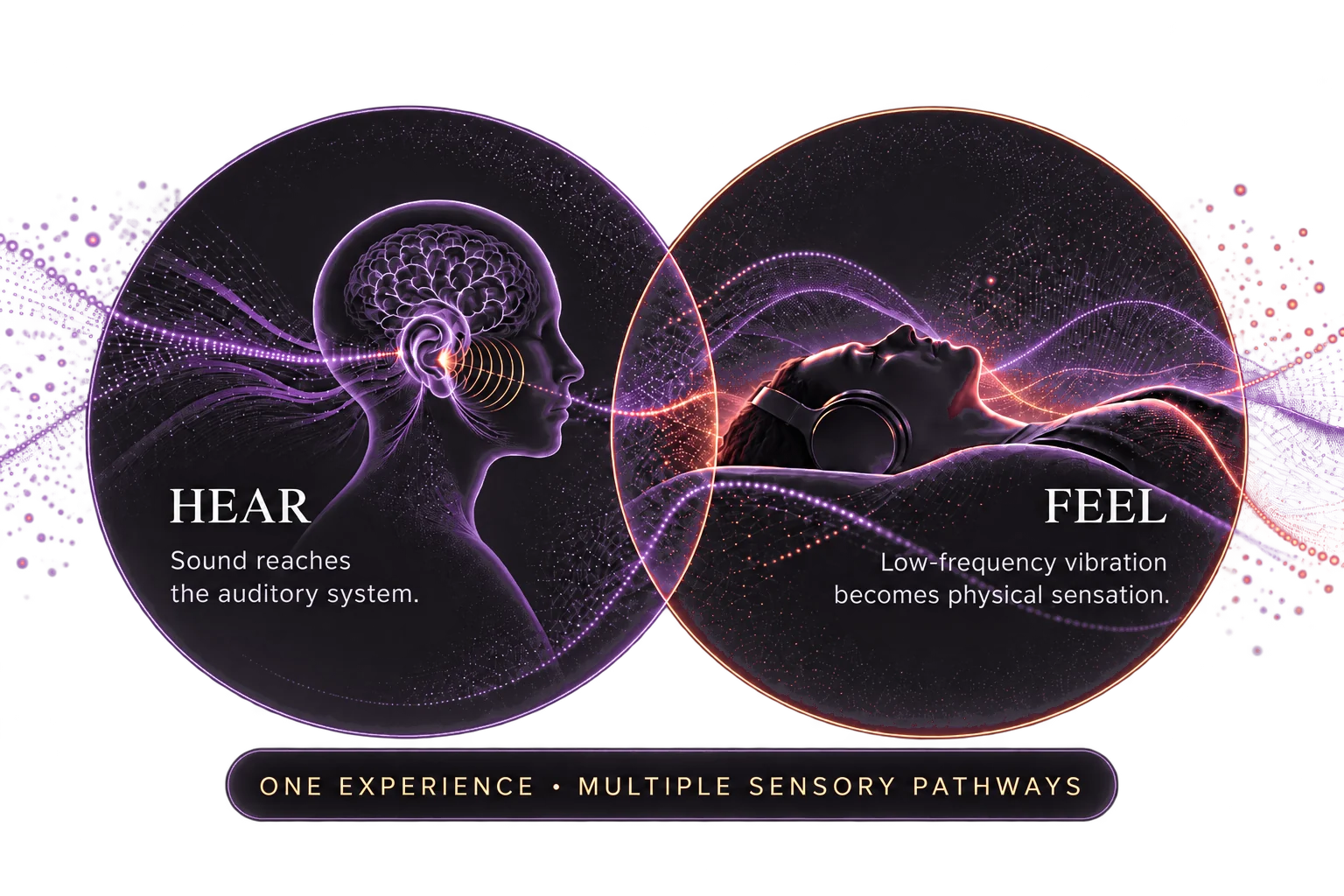
You hear the sound through your ears. You also feel part of it through the body as vibration.

Diagram showing sound reaching the auditory system and low-frequency vibration becoming physical sensation, two sensory pathways within one experience
What researchers have found

Three studies. Three very different questions.

Researchers have looked at attention, chronic pain, and acute stress to understand how people respond to vibroacoustic stimulation in very different circumstances.

“Grooving in My Body”: A Mixed-Methods Pilot Study of Vibroacoustic Therapy’s Effects on Emotion Regulation and Attention in Autistic Children Moore, Farquharson & Lotter · Healthcare · 2025
What researchers did

Eighteen autistic children ages 9 to 12 with attentional challenges participated in a six-week study at a primary school in Pretoria, South Africa. Nine received 10 vibroacoustic therapy sessions and nine served as a control group.

Researchers tested sustained, selective, alternating, and joint attention at several points throughout the study. They also observed the sessions and used child-friendly interviews to understand how the children experienced the vibration themselves.

What they found

The clearest measurable change was in joint attention, the ability to share focus with another person on the same object, event, or activity.

Joint-attention scores improved significantly across the study in the VAT group. The pattern appeared after five sessions, was stronger after all 10 sessions, and was still present one week later.

The children’s descriptions added another layer. They commonly described the sessions as calming, comfortable, enjoyable, warm, or physically relaxing. Some expressed the sensation through movement, drumming, drawings, or music rather than simply describing it in words.

Why it matters

What makes this study useful is that researchers followed attention across repeated sessions rather than relying on a single before-and-after snapshot.

They also paired formal attention measures with observation and the children’s own accounts of the sessions, giving them both measurable outcomes and a view of how the experience was actually perceived.

Vibroacoustic Treatment to Improve Functioning and Ability to Work: A Multidisciplinary Approach to Chronic Pain Rehabilitation Campbell, Hynynen, Burger, Vainionpää & Ala-Ruona · Disability and Rehabilitation
What researchers did

Researchers followed four people living with chronic pain through a multi-stage rehabilitation program.

First came five weeks of practitioner-led vibroacoustic treatment, with two sessions each week. Then participants went through a month without treatment. After that, they completed five weeks of self-directed vibroacoustic sessions four times a week, followed by another treatment-free month.

Throughout the process, researchers measured pain, mood, relaxation, anxiety, depression, disability, and perceived ability to work. Participants also kept diaries about what they noticed.

What they found

The greatest overall improvements occurred during the practitioner-led phase.

Across the four cases, the researchers reported improvements in functioning, pain, and depression. The later self-directed phase was particularly useful for pain relief and relaxation.

Participants also described becoming more aware of sensations in their bodies. During the treatment-free periods, some said the return of symptoms made the earlier effects easier to recognize.

Why it matters

The study design makes the timing useful. Researchers followed the same people through guided treatment, periods without treatment, and later self-directed use rather than looking at a single session in isolation.

That gave them a way to see how changes developed, what happened when treatment stopped, and how participants responded when they began using the approach on their own.

Effect of Low Frequency Sound Vibration on Acute Stress Response in University Students: Pilot Randomized Controlled Trial Kantor et al. · Frontiers in Psychology · 2022
What researchers did

Fifty-four university students were randomly assigned to one of two groups in a double-blinded pilot trial.

Everyone lay on the same type of vibroacoustic bed and listened to the same 20-minute musical composition.

There was one crucial difference. The experimental group received music plus low-frequency vibration. The control group heard the same music with the low-frequency component removed.

Researchers measured subjective stress and muscle relaxation before and after the session. They also measured heart-rate variability, allowing them to look at changes in autonomic nervous-system activity.

What they found

People in both groups reported lower stress and greater muscle relaxation after the session.

The difference emerged in the physiological measurements. Two heart-rate variability measures differed significantly between groups after the session in favor of the vibration condition. The researchers interpreted that pattern as greater parasympathetic activity after exposure to low-frequency sound vibration.

Why it matters

The strength of this design is the comparison. Both groups heard the same music on the same type of bed, while only one group received the low-frequency vibration.

By changing one element instead of comparing two completely different experiences, the researchers could examine whether adding physical vibration produced a measurable difference of its own.

Still Point + the research

From following the research to contributing to it.

Still Point participates in Evaluating the Effects of Vibroacoustic Therapy (VAT), an ongoing observational study conducted by Scientifica Consulting.

People who choose to participate complete a brief questionnaire before and immediately after a practitioner-led vibroacoustic session. Their responses are used anonymously to track changes in stress, relaxation, mental clarity, energy, focus, and overall well-being.

The preliminary results below show average reported changes immediately after a single session.

After one session

What decreased

Fatigue−47%
Stress−41%
Brain fog−35%
Anxiety−26%
 

What increased

Energy+53%
Relaxation+39%
Mental clarity+38%
Focus + concentration+33%
Overall well-being+33%

As of the September 2025 preliminary report, the study included 38 pre-session responses and 18 post-session responses representing 27 unique participants.
Sessions used several inHarmony devices, different audio protocols, and session lengths ranging from 9 to 66 minutes.

Experience Still Point

The research tells part of the story. The rest is yours to notice.

Start with a 30-minute reset, a deeper individual session, or a group offering.

Explore the offerings